Latest Annual Report
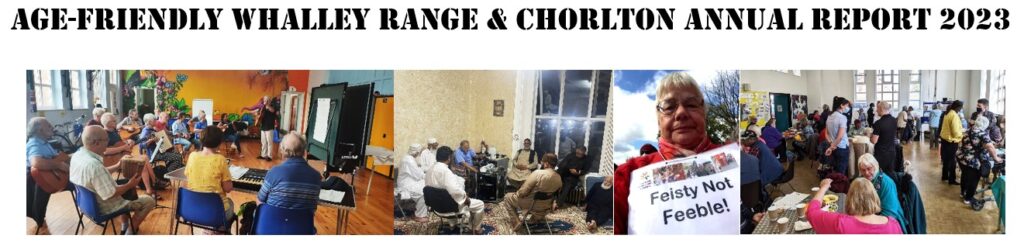
Age Friendly Whalley Range and Chorlton Annual Report 2023
We updated our Age-friendly Whalley Range and Chorlton Constitution in July 2022.
See the revised version here: Updated AFWR Ch Constitution June 2022 (2)
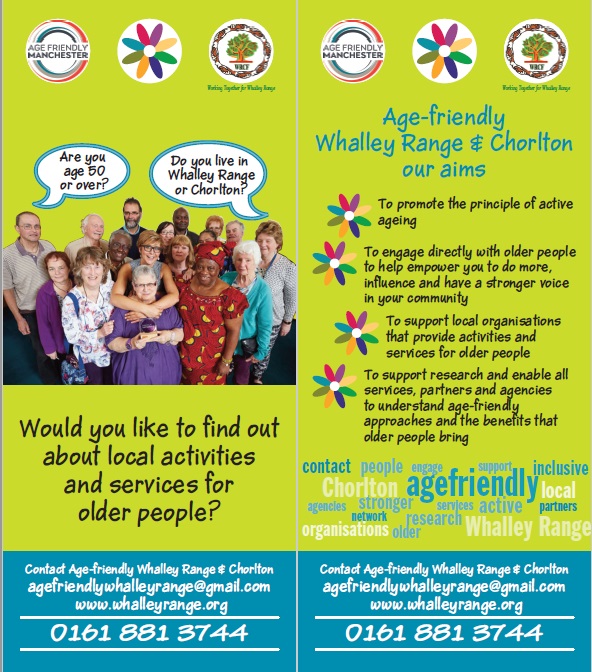
Age Friendly Whalley Range and Chorlton Annual Report 2023
We updated our Age-friendly Whalley Range and Chorlton Constitution in July 2022.
See the revised version here: Updated AFWR Ch Constitution June 2022 (2)
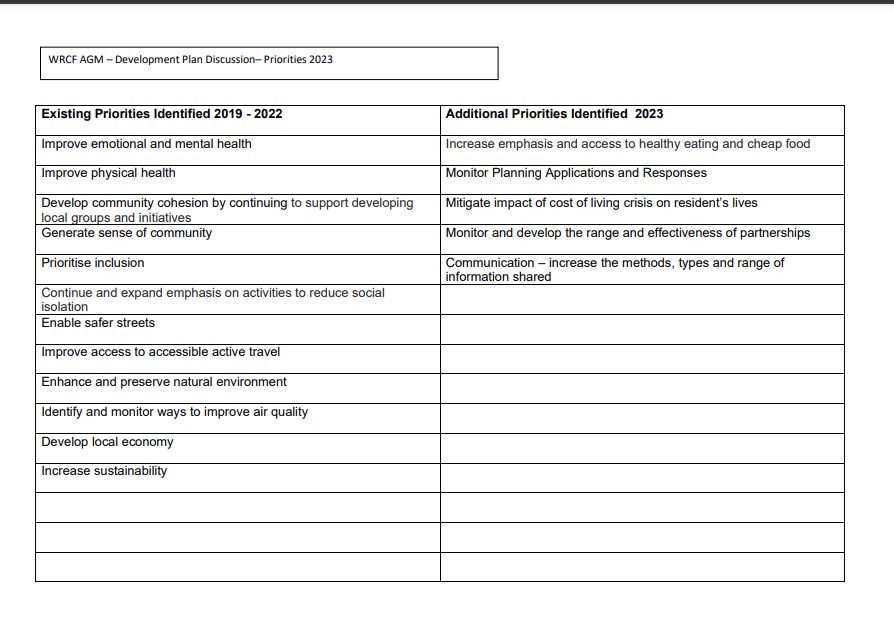
https://www.whalleyrange.org/wp-content/uploads/2020/01/WRCF-Development-Plan-2019-2024-final.pdf )
Whalley Range Community Forum Development Plan Action Framework 2022
WRCF Minutes May 2023 v4.0 (2)
WRCF Minutes July 2023 v1.0 (7)
WRCF Minutes September 2023 v3.0 (5)
WRCF Minutes November 2023 v3.0 (3)
WRCF Minutes Jan 2024 v1.0 (3)
(Update from WR Let’s Talk Clean Ait and WRCAG as shared at the meeting)
Let’s Talk Clean Air update for community forum
We hope to see you our launch of the next stage of the Clean Air project to be held on Saturday 14th January at 2.30pm at St Edmunds Church
The launch will be an action packed afternoon. Get the first viewing of our short new film – it’s Whalley Wood!
There will be light refreshments and activities for children. Bring family and friends. All are welcome! Please let us know if you’re coming – ring, email or go to https://www.eventbrite.co.uk/e/lets-talk-clean-air-film-launch-at-st-edmunds-tickets-483061198047
WE are delighted that Afzhal Khan will be there
Workshops looking at solutions will start on 15th January. Several organisations have already signed up. Please make sure yours does, as soon as possible; we are working to a tight timescale.
The workshop can be tailor made to suit your organisations needs eg part of your faith group service or activity! The film can be used to stimulate conversation and we have some exciting group activities to keep everyone engaged. Send an email- TalkCleanAirWR@gmail.com, to let us know, if you want more information.
Huge thanks to the community forum for support with managing the finances.
Our ask of you:
o Facebook: https://www.facebook.com/TalkCleanAirWR/
o Twitter: @TalkCleanAirWR
Email: TalkCleanAirWR@gmail.com
Tel: Judith: 07792 690 278
Cazz, Alex and Judith
Snowdrop Covid Memorial Curve
The snowdrop curve palette dry Whalley Range people las year should flower in February so we have organised a series of gatherings for people to talk and write about their Covid experiences with a lovely local poet, and an event to come and see the flowers blooming on february 11th. All the details are attached, the gathering dates are below
[10:25, 07/01/2023] Avril Danczak: Tuesday 17th January 1045 to 1300 at the Pavilion Café in Alexandra Park.
Tuesday 17th January at 1715 to 1930 at British Muslim Heritage Centre, College Road M16
Thursday 19th January 1045 to 1300 at the Pavilion Café in Alexandra Park.
Please see links below to the minutes of the last AGM, the agenda – which includes the nomination form for election of officers – and a shortened version of our Development Plan for review at the AGM.
We’ve included a guide to using Zoom on request.
The WRCF Annual Report and Treasurer’s Report will also be available soon.
Agenda and Nomination form for election of Officers for WRCF – Feb 2022 (1)
Shortened devel plan AGM Jan 2022 (1)
Whalley Range is a diverse area of South Manchester in relation to housing type, the natural environment and population, of approximately 16,000 people. Made up of 6,500 households, over 1,000 children living in low-income families (5 times that of Chorlton) and over 2,500 people living in single households (twice that of adjoining Fallowfield).
We have the most ethnically diverse community in the city, with over 4,000 residents of Asian origin, 2,000 of African Caribbean origin, and other long-standing communities from eastern Europe, especially from Poland many arriving in the 1940s. As a result, 56% of school pupils have a first language that is not English, and we have a range of places of worship including Mosques, Sikh, Hindu and Hari Krishna temples and several Christian denominations.
The range of residential properties can be explained by our history. The area was first built on in 1836 when Samuel Brooks (born in Whalley, Lancashire) bought Jacksons Moss, an area of clay pits and peat bog, which he drained and built villas as “a desirable estate for gentlemen and their families” to escape the congestion of the city, with tree lined avenues, many with extensive sewers and drainage culverts. Whalley Range was one of Manchester’s, and probably the world’s, first suburbs. The area included farmland, large private estates and houses, large training colleges, and several churches.
By the 1960s many of the larger houses, some of which had been used as consulates, and residential homes, had become houses in multiple occupation.
By the 80’s the area had a reputation as a red-light district. Some properties fell into disrepair, were demolished and now have blocks of flats, and some small private estates.
The range of housing types has resulted in a mixture of family types and sizes. Our area has one of the highest levels of rented accommodation in the city, most of it private but there are also several housing Associations, (one of which incorporated a housing cooperative) two of which run large supported living schemes for older people.
The housing types means that there is a high level of single person households with the risks of social isolation. Conversely in some areas of the ward families experience overcrowding and the stresses that can bring.
The diversity of the population and housing type means we have particular health and wellbeing concerns.
Ten percent of the population are deemed to be in need of ‘intensive support’ (e.g., in relation to smoking, alcohol consumption, stress and anxiety) (twice that of adjoining Chorlton). In addition, we have twice the England average of deaths from coronary heart disease. Health inequalities within the black, Asian and minority ethnic communities have resulted in higher rates of mortality and morbidity from conditions such as diabetes cardiovascular disease, certain cancers such as Myeloma, prostate, liver and bowel cancer and mental health disorders. These communities have also been disproportionately affected by the Covid pandemic.
These particular health and wellbeing factors should direct the services in our area and encourage us all to make the most of and build on our assets.
The diversity of the ward also means that we have many assets.
Although lacking a central shopping area, we have several areas of shops with access to fresh fruit and vegetables, and several cafes and bars. There are five allotment areas, two parks, with Alexandra Park opened in 1870 designed to “deter the working men of Manchester from the alehouses on their day off”. Manley Park being the site of Manley Hall, and then an underground air raid shelter for 500 people in the first world war.
Several large buildings have become schools, the former Aquarium (built 1872) becoming St. Bede’s College and the former College built in 1840 for the training of non-Conformist ministers, later becoming a trade union centre and now a community focused Muslim Heritage Centre. Many of these buildings, are protected by the conservation area, designated in 1991 following residents’ campaigns to protect buildings and trees.
Much of the terraced housing around Clarendon Road was built by Welsh labourers at the end of the 19th century to house the workers for Manley Hall, situated where Manley Park is now, they also built Calfaria (the Welsh Chapel), located beside Manley Park Methodist Church.
Whalley Range has a rich history in political activism and protest, particularly in Alexandra Park – where in 1892 60,000 people marched to the park in support of a shorter working week. In 1908 Suffragettes rallied for the right to vote. Today some of these traditions continue through campaigning groups on peace and justice and for action on climate change.
There are a wealth of local community and voluntary sector organisations, age friendly and youth groups – and local street mutual aid groups, providing the opportunity to Connect with others locally and Keep Learning, be Active and Take Notice and get involved through activities and volunteering (Give). (See the 5 Ways to Wellbeing elsewhere on the Whalley Range map – new edition in progress).
Our mental and physical health and wellbeing are closely linked to our environment, and the changing world around us.
We can aim to have more control over our lives, improving our health and that of our environment in many ways
Clean air
Cleaner air reduces chest conditions such as asthma. We can improve the quality of our air by driving less, stop idling when parked (especially outside schools), having traffic free street events, keeping our green environment, e.g., by tree planting( e.g by the Climate Action Group), and not burning unseasoned (undried wood) either in our homes or gardens.
Grow and eat local
It is a pleasure to be able to grow your own food, flowers, herbs whatever size of space you have. House plants purify the air. Locally grown food tends to be fresher, have more nutrients, tastes better, is often cheaper, has fewer pesticides and herbicides, reduces packaging and transport costs and emissions.
Being outside provides you with essential Vitamin D from sunlight and gives you important exercise in your ‘green gym’. Being outside boosts our mental health within 5 minutes.
Eating meat only once or twice a week will allow farmers to rear animals in more sustainable and humane ways, reduce carbon emissions and make you healthier too.
Exercise
Not using a car is good for our health, by breathing fresh air, being out in nature, taking more exercise, and having more social interactions. Not only does this reduce carbon emissions it makes us feel good too!
The Walk Ride Group is working on ways to reduce speeding, prevent the blocking of pavements and help people feel safer cycling
The Age Friendly group installed benches to have a rest while exercising.
Chemicals
Reducing the use of chemicals both within our homes, gardens, and community Is good for our health and the environment. Chemicals washed into water courses and environment can aggravate eczema, allergies and asthma, affect our fertility and damage fish and other creatures.
The Whalley Rangers, in partnership with the City Council, have undertaken to remove unwanted weeds from pavements, instead of spraying harmful herbicides.
Welcoming everyone
Whalley Range has a long history of welcoming people to play their part in developing the city, resulting in a diverse community. From the workers who moved into the city from the surrounding rural areas in the 1800s, through to people fleeing the effects of war, famine, and climate change.
Some buildings and organisations link to this fascinating history and reflect our diverse community and offer a range of health and wellbeing activities.
Mental health
We have many supports to good mental health e.g. lovely parks, sports clubs. The CELEBRATE festival and other local events, bring uplifting music, neighbourly connection and encourage people to get involved with things. Joining a club, or group, along with volunteering is a powerful protector of good mental health. Young people are supported by WRYOA, and Community on Solid Ground who provide activities . During Covid a network of mutual aid groups were set up linking people with their neighbours using technologies new and old.
Parks and open spaces
Our parks are vital for health…green spaces are calming and rejuvenating, allowing access to exercise, sports, volunteering, interactions, events, and clean air. Sunlight exposure improves our vitamin D levels (vital for strong bones muscles and good immunity) .Trees are valuable stores of carbon and help to reduce climate change. In built up areas our parks are vital for wildlife.
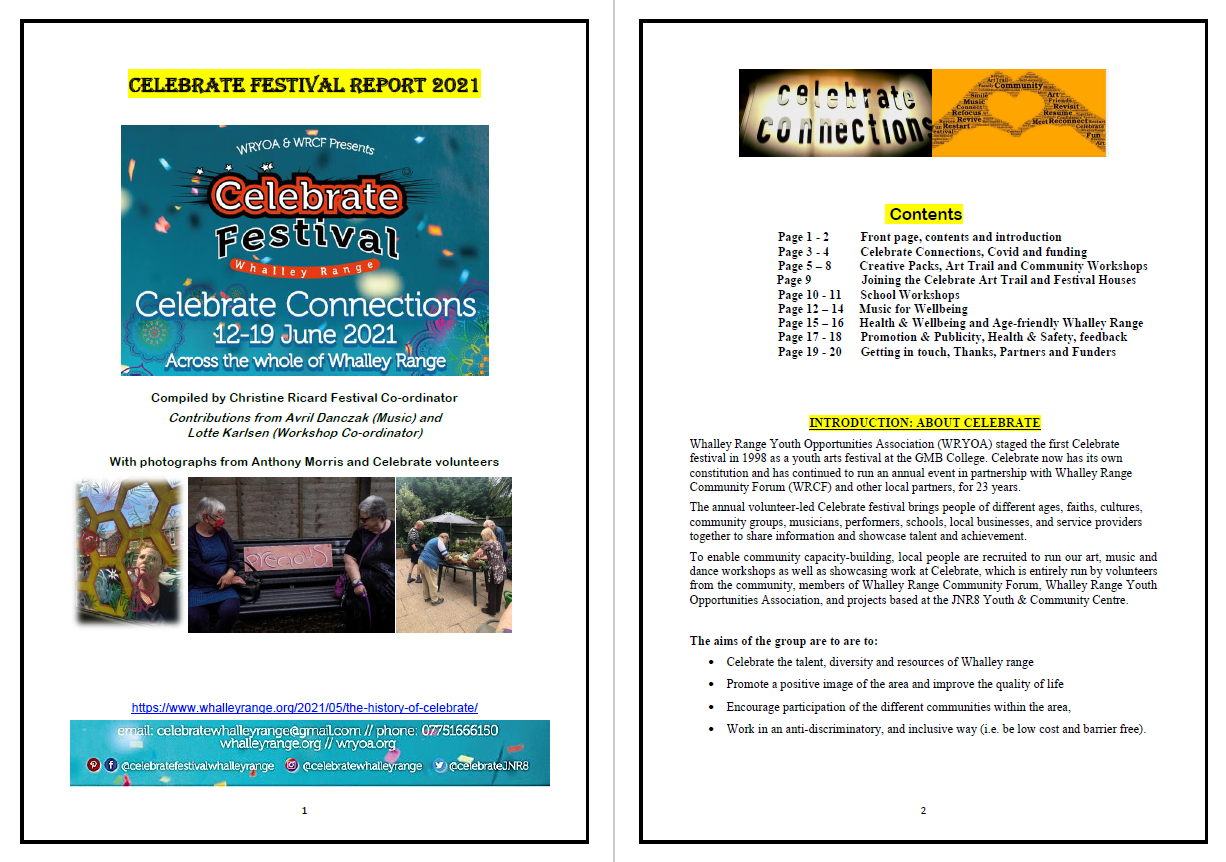
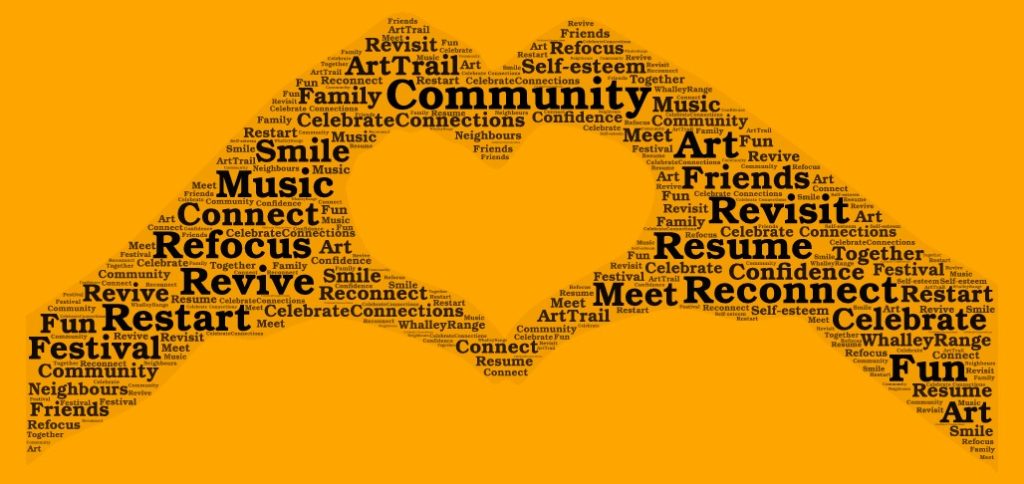
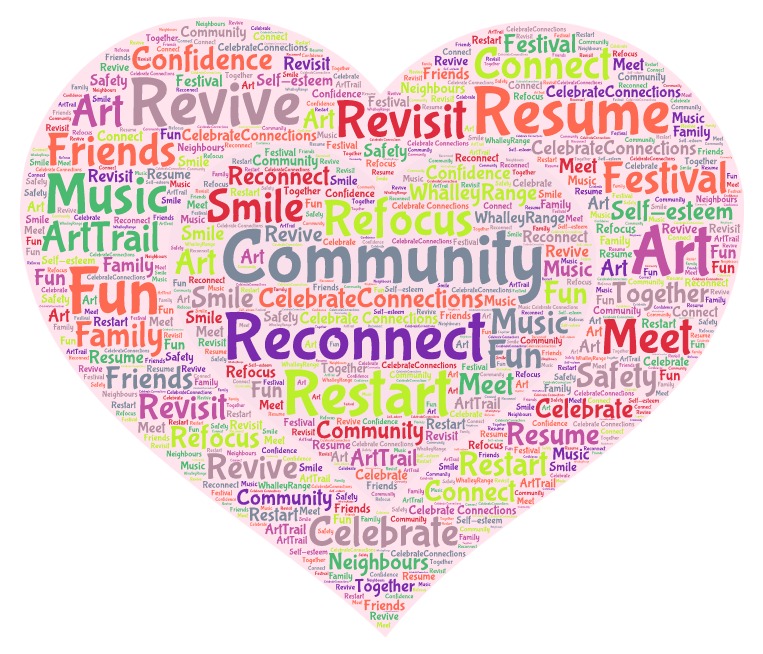
Our theme is Celebrate Connections – and because we haven’t been able to get together for so long, we want to do something positive, all get involved, reconnect and look forward to when we can meet up again.
Of course we couldn’t hold a Festival last year because of the pandemic – and we still can’t hold our usual face-to-face event in the park this year, but we are planning lots of smaller events, activities and workshops between Saturday 12th June – Saturday 19th June – when the weather will be warmer and restrictions may be a little more relaxed…and of course we will be following government guidelines to keep our community safe.
We want to work together to make an Art Trail throughout Whalley Range – so that when people go for their daily walks they will see some inspiring and beautiful colours and will feel more connected to neighbours, friends and family. (maybe send us a photo or two for our gallery in the JNR8 windows!)
Celebrate week 12th – 19th June. We plan to put together Celebrate Connections packs for people who would like to get involved – with a selection of arty-crafty goodies/instructions to decorate your windows and outside your doors. The packs will contain template stencils for you to make beautiful Peace Mandalas, Rangoli patterns or Islamic designs to colour in or using chunky chalks on your doorstep – so people of all ages and abilities can join in! We will also be working with some residents to decorate the front of their houses.
We are planning to have small events and pop-up music and performance at different places during the week – celebrating local talent. There are some amazing musicians, performers and artists in Whalley Range.
And if we are able – a procession or some smaller processions throughout Whalley Range to finish off the week of Celebrate Connections – bringing our community back together again!
We will be working with our groups and facilitators – who can’t run their usual face-to-face workshops – in a number of ways. We have some funding to run small scale workshops and performances to be delivered to small/closed groups leading up to the events – in schools and community centres, housing schemes etc. and will be planning and discussing our offer over the coming weeks.
We have a small budget which we will offer to some of our local community groups who can apply for up to £100 for materials and expenses to run activities that fit in with our theme Celebrate Connections!
On our website during the Celebrate week we will promote (free) interactive, participatory local arts and crafts activities, music performances etc – tell us what you’re planning for that week and we’ll add it to the ‘virtual programme’ Or why not run one of your sessions specifically for the event?
Get in touch if you would like help to run an activity online.
We will also feature and promote health and wellbeing support groups and related activities: are you part of an online meditation group/Tai Chi/Yoga/ etc happening during that week? Why not get more people involved by running a free introduction session or sending us details to include in the ‘programme’?
We would really like to hear your ideas too: what can we do to feel more connected?
We want to work together across Whalley Range: we have a fantastic and diverse range of groups, musicians, community organisations, Faith groups, schools and more. Our mutual aid/street groups have been a lifeline to some of us and have brought people together to share ideas, improve our spaces and support each other.
And at the end of the week – depending on the rules – we are hoping we can have a Community Connections procession or several smaller processions to dress up, play some hand made instruments and wrap up the Festival!
Interested? Contact Chris or Lotte on 0161 881 3744, or communityforumwhalleyrange@gmail.com